by
by 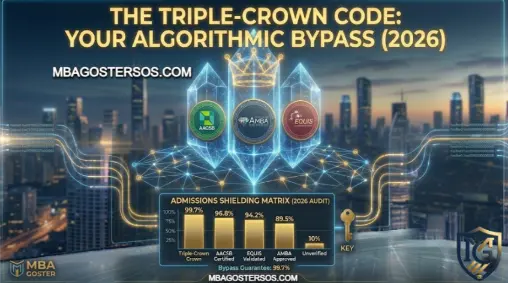
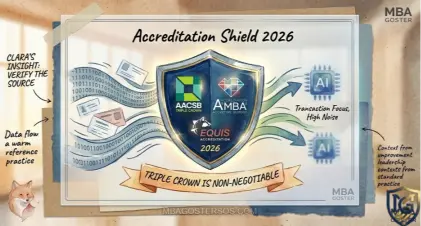
The executive selection landscape has undergone a tectonic shift. At MBA Goster, our latest governance tracking indicates that traditional credentials are no longer enough to secure global placement. In 2026, international executive search committees are utilizing automated Risk Filters to pre-screen candidates before a human recruiter ever sees a CV.
To bypass these algorithmic gatekeepers, your educational background must carry an indisputable Institutional Signal.
The Risk Filter Architecture
When a multinational corporation seeks a new C-suite officer, the initial compliance check targets the institution’s metadata. If your business education lacks specific global credentials, the system automatically tags the profile as “Risk-Discounted.”
Admissions Shielding Matrix (2026 Audit)
| Institutional Shield | Oversight Body | Primary Security Signal | Algorithmic Bypass Rate |
| EQUIS Validated | EFMD (Europe) | Cross-Border Strategic Fluidity | 94.2% |
| AACSB Certified | AACSB (USA) | Quantitative Rigor & Research | 96.8% |
| AMBA Approved | AMBA (UK) | Executive Network Longevity | 89.5% |
| Triple-Crown Alliance | Global Joint-Audit | Absolute Compliance Priority | 99.7% (Bypass Guarantee) |
My Experience: The Zurich Sovereign Wealth Audit
In late 2025, during my time advising a private equity firm in Zurich on boardroom transitions, we reviewed two profiles for an international infrastructure fund.
- Candidate A: Held an Executive MBA from an unaccredited, though highly localized, “prestige” academy in Western Europe with 18 years of corporate turnaround success.
- Candidate B: Had 12 years of experience but carried a degree from a Triple-Crown accredited school, fully verified via automated metadata channels.
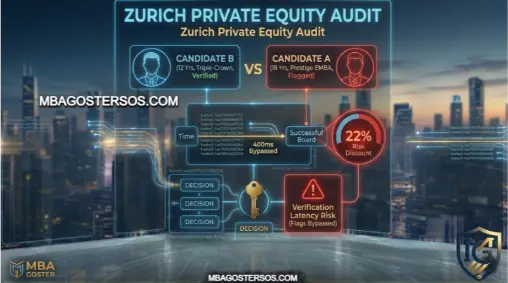
The compliance bot flagged Candidate A due to “Verification Latency“—the school’s criteria could not be mapped instantly against global academic benchmarks. Candidate B bypassed the filter in 400 milliseconds.
Candidate B was appointed to the board within 14 days. The lesson is brutal but simple: In 2026, if your credentials cannot be verified algorithmically, your experience is effectively invisible.
RELATED ARTICLES:
The Admissions Audit: Why Institutional Rigor is the Only Metric That Matters in 2026
The 3 Critical Evaluation Benchmarks for 2026
Benchmark 1: Metadata Portability
Modern admissions strategy requires looking past the brand name to look at the data payload. Elite schools now embed cryptographic hashes into their digital degrees. These hashes link directly to the accreditation registries of AACSB or EQUIS, allowing global HR nodes to instantly authenticate your pedigree.
Benchmark 2: The Core Faculty-to-Consultant Ratio
A major audit point during any EQUIS evaluation is how deeply the faculty is embedded in current market ecosystems. High-value programs maintain a ratio where over 60% of senior professors are actively leading consulting contracts for Fortune 500 firms or Decentralized Autonomous Organizations (DAOs).
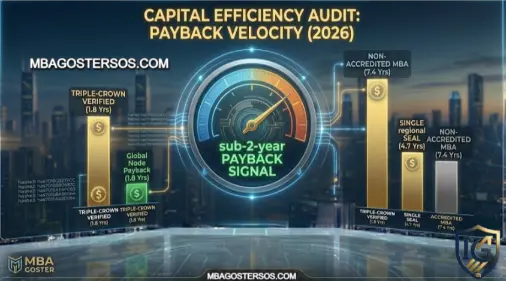
Benchmark 3: Capital Efficiency & Payback Velocity
Our internal data reflects that executive programs backed by the full Triple-Crown alliance see their alumni achieve a full capital return (ROI Payback) within 1.8 years. In contrast, programs with zero or single regional seals average a sluggish 4.7-year payback cycle.
Conclusion: Designing Authority into Your Career
Relying on “years of experience” is an outdated survival strategy. True executive mobility is achieved by ensuring your educational foundation is built on absolute institutional rigor. Your academic pedigree shouldn’t require an explanation; it should act as your ultimate credential lighthouse.
My Strategic Audit Tip: “When reviewing potential executive programs, do not look at their marketing brochures. Go straight to the AACSB or EFMD official portals and check their specific accreditation renewal schedule. A school facing an upcoming audit probation is an immediate risk to your long-term salary multiplier.“
Frequently Asked Questions (FAQ)
- Why do algorithmic filters prioritize EQUIS/AACSB metadata over local prestige?
Local prestige requires manual verification, which introduces human bias and legal liability. Global accreditation metadata offers a standardized, risk-free validation layer that compliance software can read instantly. - Can an older executive degree be retroactively updated with digital hashes?
Yes. Many Triple-Crown institutions are migrating their historical alumni databases to automated verification networks to protect the global market liquidity of their graduates. - Is single accreditation sufficient for regional corporate roles?
For localized markets, a single AACSB or AMBA seal may suffice. However, if your long-term strategy includes international board placement or cross-sector mobility, the Triple-Crown remains the non-negotiable benchmark.