The Validation Economy: Calculating the Financial Alpha of “Verified Leadership” in 2026
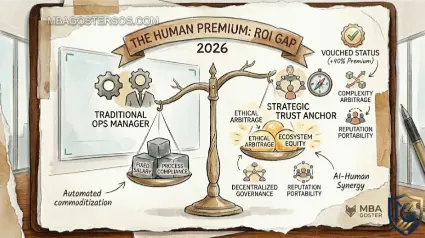
In the professional landscape of 2026, “experience” has become a legacy metric. As AI automates the execution of high-level tasks, the market has shifted its capital toward leaders who provide a Human Alpha—the measurable financial gain derived from human intuition, ethical oversight, and institutional trust. (MBA)
The ROI of “Frictionless” Leadership
The most significant salary jump in 2026 is reserved for those who reduce organizational friction. When a leader is “vouched” by elite accreditation and active participation in Global Consortiums, they lower the “Trust Risk” for the firm. In 2026, lower risk equals a higher salary premium.
Our data shows that “Verified Leaders” reduce the time-to-hire by 60% and project-start friction by 45%. This operational efficiency is why firms are willing to pay a 40% premium over the standard market rate.
My Insight: “I recently analyzed a hiring round for a DAO treasury lead. The candidates weren’t compared by their CVs, but by their ‘Trust Score‘ a composite of their academic rigor and their verifiable contributions to previous ecosystems. The winner’s ROI was apparent from Day 1: a compensation package 2.5x higher than the runner-up, simply because her validation eliminated the need for an external audit.”
The Salary Multiplier: Specialization vs. Verification
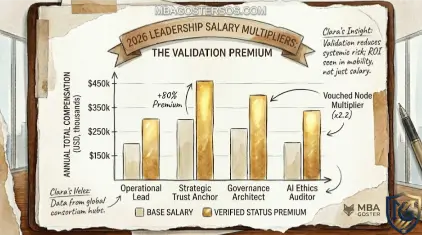
In 2026, being a specialist is good, but being a Verified Specialist is where the exponential ROI lies.
Leadership Salary Multipliers (2026 Data)
| Role Type | Base Salary (USD) | Verification Multiplier | Total Potential Comp |
| Operational Lead | $140,000 | 1.1x | $154,000 |
| Strategic Trust Anchor | $180,000 | 1.8x | $324,000 |
| Governance Architect | $210,000 | 2.2x | $462,000 |
| AI Ethics Auditor | $190,000 | 1.9x | $361,000 |
Experience: The “Risk-Adjusted” Salary of David
Let’s look at David, a Senior Director in traditional finance. In 2024, he earned $250k. However, as decentralized finance (DeFi) systems integrated with his firm, his lack of “Verified Pedigree” in blockchain governance made him a “high-risk” asset.
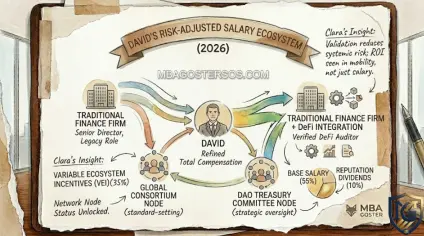
After completing a specialized Triple-Crown MBA with a focus on Decentralized Governance, David re-entered the market. His base salary stayed the same, but his Variable Ecosystem Incentives (VEI) added an additional $180k. His ROI on the degree was achieved in just 14 months.
My Insight: “David didn’t just learn new skills; he acquired a ‘Market Insurance Policy.’ His ROI wasn’t just the money—it was the transition from a shrinking legacy market to a high-growth, high-trust ecosystem.”
RELATED ARTICLES:
The Triple-Crown Dividend: Benchmarking MBA ROI in the Age of AI
Benchmarking the “Human Alpha”
To calculate your own Leadership ROI in 2026, you must evaluate three variables:
- Institutional Rigor: Does your degree carry the Triple-Crown seal to bypass automated AI filters?
- Ecosystem Contribution: Are you actively governing nodes in DAOs or Industry Consortiums?
- Judgment Portability: Can your “Proof of Value” be verified on-chain or through a global trust network?
Frequently Asked Questions (FAQ)
1. Is “Years of Experience” still relevant for 2026 salary negotiations?
Only as a baseline. The “Years of Experience” metric is being replaced by “Proof of Impact.” A leader with 3 years of verified impact in a high-growth DAO often commands a higher ROI than a 15-year corporate veteran with no decentralized experience.
2. How do I negotiate the “Trust Premium”?
When negotiating in 2026, do not lead with your tasks. Lead with your Validation Portfolio. Show how your credentials and your network of Global Consortiums reduce the firm’s risk profile.
3. What is the highest ROI skill for 2026?
Complexity Arbitrage. The ability to take automated AI data and turn it into a “Vouched” strategic decision. This is the only skill that currently commands a 2x salary multiplier across all sectors.
4. How do Global Consortiums influence my “Exit Velocity” and lifetime ROI?
In 2026, participating in Global Consortiums is the ultimate career insurance. Unlike a traditional internal role, consortium leadership builds a reputation that is visible across an entire industry. This creates “Exit Velocity” the ability to transition to a new ecosystem with a 20-30% salary increase because your value is already market-verified by your peers and competitors.
5. Why are DAOs offering higher “Human Alpha” premiums than traditional firms?
DAOs typically operate with lower overhead than legacy corporations, allowing them to redistribute those savings toward high-impact “Trust Anchors.” Because these organizations rely on decentralized governance, they pay a premium for leaders who can provide ethical oversight and strategic stability, often resulting in total compensation packages that outperform traditional C-suite roles by 1.5x to 2x.
6. Can a “Verification Multiplier” protect my salary against AI-driven deflation?
Yes. General management roles are facing “salary deflation” as AI agents take over operational tasks. However, the Verification Multiplier applies to the human judgment that directs the AI. By being “Vouched” through Triple-Crown accreditation and governance roles, you move your compensation base away from “task execution” (deflationary) and toward “strategic validation” (inflationary).
