Decision Architecture: The $500k Executive Skill in the Post-AI Economy
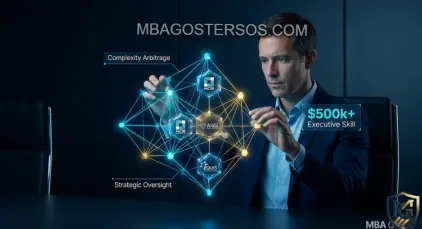
In the executive market of 2026, execution is no longer a metric of value. AI has democratized the ability to “do,” creating a critical vacuum in the ability to “decide.” At MBA Goster, our annual compensation audit reveals that salaries exceeding the $500,000 threshold do not belong to technical experts, but to Decision Architects.
The End of Operational Leadership
The 2024 leadership model, based on KPI management and task tracking, has collapsed. Today, autonomous systems optimize processes in real-time. The new ROI of leadership is found in Complexity Arbitrage: the ability to take ultimate responsibility for decisions where data is contradictory or ethically ambiguous.
For elite recruitment algorithms, a leader without Triple-Crown (AACSB, AMBA, EQUIS) institutional validation is viewed as an operational risk. Without that “trust anchor,” your judgment lacks the necessary backing to be processed by global governance nodes.
Value Analysis: The “Human Premium” in Decision Making
| Leadership Level | Primary Responsibility | Salary Multiplier | Autonomy Score |
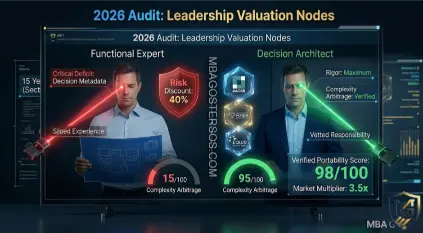
| Operational (Siloed) | Process Execution | 1.0x (Base) | 15/100 |
| Strategic (Vouched) | System Oversight | 1.8x | 60/100 |
| Decision Architect | Governance & Ethics | 3.5x | 95/100 |
The Concept of “Vetted Responsibility”
A Decision Architect does not just choose a path; they act as a Vetted Node. When an AI system proposes a merger or a strategic pivot, the “Triple-Crown” leader is the one who signs off on the ethical and financial validity of the move. This signature is what Global Consortiums buy at a premium: Human Judgment Insurance.
My Strategic Advice: “Invest in your Signature, not your Function“
“In 2026, the market does not pay you for what you know how to do, but for the risk you are capable of absorbing. If your signature is not backed by global accreditation, your risk-absorption capacity is zero for international compliance systems.“
RELATED ARTICLES:
The Governance Premium: Masterminding Leadership ROI in the Age of Autonomy
My Experience: The “Invisible” Director
I recently worked with “Roberto,” a VP of Operations with 15 years of success in the retail sector. Despite his track record, Roberto was discarded for a Chief Governance Officer position at a decentralized logistics consortium.
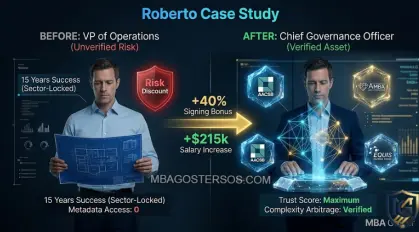
The reason? His profile lacked Rigor Metadata. To the selection algorithm, his experience was “unverified noise.” After completing an Executive Leadership program at a Triple-Crown institution, Roberto didn’t just regain visibility; he was hired with a 40% signing bonus, simply because his judgment now carried a “Global Audit Seal.”
Conclusion: The New Power Hierarchy
Career and Leadership in 2026 are disciplines of Governance. By securing Triple-Crown validation, you are not just buying a degree; you are acquiring a License to Decide. In a world where AI can predict almost everything, verified human judgment is the only asset that maintains absolute scarcity and, therefore, infinite value.
Frequently Asked Questions (FAQ)
1. What exactly is Complexity Arbitrage?
It is the ability to provide strategic direction when AI presents multiple scenarios with similar probabilities. The human leader intervenes to align the decision with board values and long-term sustainability.
2. Why is the salary of “unaccredited” leaders falling?
Because the market applies a Risk Discount. Without external validation (Triple-Crown), companies must spend more on background audits and liability insurance, resulting in a lower salary offer for the candidate.
3. Can a startup leader benefit from Decision Architecture?
Absolutely. In fact, 2026 startups depend on the reputation of their leaders to attract investment from DAOs and institutional funds that demand governance rigor from day one.
4. How do I start building my Autonomy Score?
Begin by auditing your current credentials. If you lack Triple-Crown backing, look for “Bridge“ programs or high-level postgraduate certifications that inject those trust metadata into your professional profile immediately.
