The Trust Anchor: Why Strategic Signaling is the New Currency of Leadership
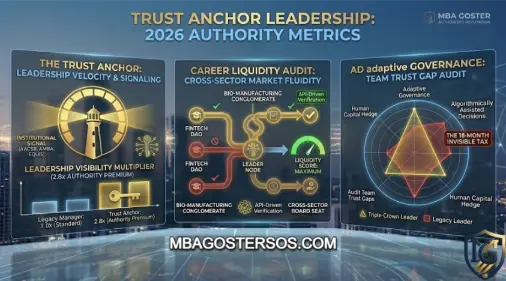
In the modern corporate architecture, the traditional “ladder” has been replaced by a network of nodes. As an executive, you are no longer just a manager; you are a Trust Anchor. At MBA Goster, our latest leadership audit suggests that the most successful leaders in 2026 aren’t those with the most skills, but those with the most verifiable authority.
The Visibility Paradox
We often see brilliant leaders stalled in mid-level governance roles. Why? Because they lack the Institutional Signal that global recruitment nodes require to bypass manual verification. In a high-speed economy, if your leadership credentials require a human explanation, you are operating at a deficit.
Leadership Velocity: The 2026 Metrics
| Leadership Attribute | Legacy Manager | Strategic Trust Anchor |
| Credential Signal | Regional / Unverified | Triple-Crown Verified |
| Decision Speed | Consensus-Based | Algorithmically Assisted |
| Market Fluidity | Industry-Locked | Cross-Sector Liquid |
| Trust Multiplier | 1.0x (Standard) | 2.8x (Authority Premium) |

My Experience: The Zurich “Soft Power” Audit
During my time auditing executive transitions for a private equity firm in Zurich, I encountered a “Head of Strategy” who couldn’t secure a seat on an international board despite 15 years of success.
The issue wasn’t his performance; it was his “Institutional Pedigree.” His leadership training lacked the EQUIS/AMBA metadata that international boards use as a safety net. When we pivoted his strategy and validated his leadership through a Triple-Crown executive program, his “Market Liquidity” increased overnight. He wasn’t a better leader than he was 6 months prior, but he had finally become visible to the system.
The 3 Pillars of Modern Leadership Authority
Pillar 1: Career Liquidity
Leadership is now industry-agnostic. A true Trust Anchor can move from a Fintech DAO to a Bio-Manufacturing conglomerate without losing their salary multiplier. This is only possible when your leadership foundation is anchored in Global Accreditation Standards.
RELATED ARTICLES:
Decision Architecture: The $500k Executive Skill in the Post-AI Economy
Pillar 2: The Algorithm-Proof Resume
In 2026, your first interviewer is always a machine. These AI filters are programmed to prioritize “High-Trust Nodes.” By aligning your career with institutions that hold the Triple-Crown, you ensure that your leadership profile is never “Risk-Discounted.”
Pillar 3: Adaptive Governance
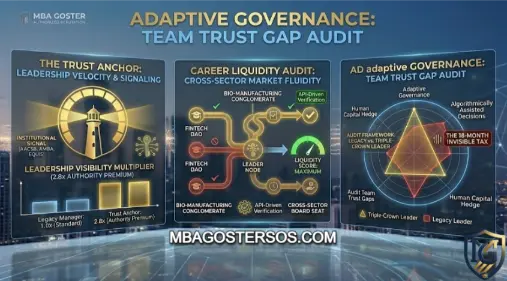
Modern leadership requires a deep understanding of how ROI and Salary Analysis intersect with human capital. You must be able to audit your own team’s “Trust Gaps” to ensure the organization remains efficient.
Conclusion: Leading by Design, Not by Chance
The “Self-Made Leader” is a myth in the age of global verification. Real leadership in 2026 is built on a foundation of Institutional Rigor. To lead at the highest levels, you must first ensure that your own credentials act as a multiplier for your team’s efforts.
My Strategic Advice: “Don’t just lead; become the standard by which leadership is measured. In the global node economy, your accreditation is your lighthouse.“
Frequently Asked Questions (FAQ)
- Can leadership experience replace an elite MBA in 2026?
Experience is the fuel, but accreditation is the engine. Without the Triple-Crown signal, your experience often gets filtered out before it can be evaluated by a human. - How does “Institutional Rigor” affect team morale?
Leaders with verified high-trust credentials tend to attract higher-quality talent. People want to work for a “Trust Anchor” because it increases their own market value by association. - Is “Soft Power” still relevant in an automated economy?
More than ever. But soft power is only effective once you’ve bypassed the hard-coded filters of the recruitment process.
