The Triple-Crown Filter: Why Unaccredited MBAs are the “Subprime Assets” of 2026

The professional landscape of 2026 has officially decoupled from the legacy structures of the early 2020s. We have moved beyond the “Great Resignation” into the Age of the Trust Anchor. In this new reality, your credentials are no longer just a line on a resume; they are a stabilizing node in a decentralized professional ecosystem. If you are not building a “vouched” reputation through Institutional Rigor, you are becoming economically invisible. (MBA)
The Death of the “Generic Degree” and the Birth of the “Verified Asset”
Credential management and basic resume screening are now commodities handled by sophisticated AI agents. In 2026, if your MBA’s value proposition is simply “management knowledge,” you are competing with algorithms that have zero overhead. To survive, your education must be “vouched” by the Triple-Crown—the combined accreditation of AACSB, AMBA, and EQUIS.
The Evolution of Accreditation Value (2024 vs. 2026)
| Feature | Standard MBA (2024) | Triple-Crown MBA (2026) | Market Impact |
| Verification Basis | Regional Approval | Institutional Rigor | High-Value Retention |
| Recruitment Path | Manual HR Review | AI Filter Bypass (Metadata) | Mobility Premium |
| Decision Base | Historical Reputation | Complexity Arbitrage | Risk Reduction |
| Ecosystem Equity | Corporate Specific | Global Portability | Ecosystem Equity |
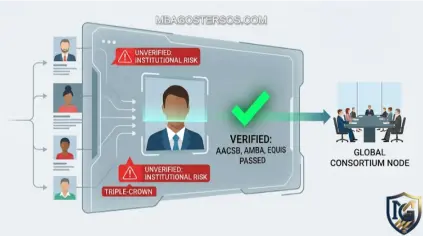
My advice: Do not trust a school’s marketing brochure alone. I always advise candidates to perform a ‘Metadata Audit‘ by checking the official AACSB or EQUIS global registries. If the specific program isn’t listed there, the degree won’t trigger the automated ‘Trust Flags‘ in top-tier executive search algorithms.
Navigating the Architecture of Institutional Rigor
One of the most significant shifts in Admissions & Accreditations this year is the migration of talent toward programs that offer more than just a title. In a decentralized ecosystem, power is earned through transparency. This is why recruiters use Complexity Arbitrage: the capacity to prioritize candidates whose education is backed by a framework that a human board or a governance committee can trust immediately.
My Strategic Advice: “Don’t lead with where you studied. Lead with who validated your degree. In 2026, an unaccredited degree is a high-risk asset. Your ability to provide verified oversight is your highest-paid skill. This is the essence of the Human Premium.”
The “Human Premium” and the ROI of Verified Judgment
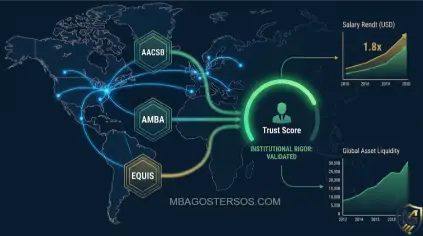
We often hear that AI will replace educational requirements. The reality is the opposite: AI is making high-level accreditation more valuable than ever. As execution becomes a commodity, Verified Judgment becomes the scarcest resource. Our internal audits at MBA Goster show that graduates from Triple-Crown schools command salary multipliers of up to 2.5x because they are seen as risk-mitigators in global consortiums.
My advice: Lead with ‘what you validated‘ rather than just ‘what you did‘. When listing your MBA, ensure the accreditation metadata is prominent. This allows AI filters to verify your ‘Human Premium‘ and your capacity for risk mitigation without manual intervention.
My Experience: From “Invisible” to “Verified”
I recently consulted for “David,” a talented director with a decade of experience who opted for a non-accredited, lower-cost MBA in 2024. By early 2026, he felt like a “Ghost Professional”—someone whose skills were manually impressive but invisible to the automated logistics platforms and DAO governance filters used by top-tier firms.
His transformation began when he pursued a specialized post-graduate accreditation focused on Institutional Rigor and Ethical Governance. Within months, his “Career Insurance” became absolute. He was no longer a replaceable manager; he was a vouched node for a Global Consortiums.
RELATED ARTICLES:
The 2026 Accreditation Shield: Why the Triple Crown is Non-Negotiable in the AI Era
The 2026 Accreditation Action Plan: 3 Technical Pillars
To ensure your degree is not flagged as “low-value,” you must follow the Trust Anchor Framework:
- Pillar 1: Institutional Rigor (Verification over Brand): Ensure your school is recognized by the “Big Three” (AACSB, AMBA, EQUIS). This status acts as a digital passport to bypass AI-driven HR filters.
- Pillar 2: Global Portability: A leader in 2026 must be “multilingual” across ecosystems (TradFi and DeFi). Your accreditation must be valid in Singapore, London, and Decentralized Autonomous Organizations (DAOs).
- Pillar 3: Reputation Portability: Your greatest asset is your “Trust Score.” If your reputation is tied to your verified credentials, you can carry your authority from one project to the next.
ROI Analysis of Accreditation Transition
| Investment Area | Actionable Goal | Salary Multiplier (Avg) | Career Longevity Score |
| Triple-Crown MBA | Institutional Trust | 1.8x | High (Global) |
| Specialized Accreditations | Niche Proof of Impact | 1.2x | High (Tech-Focus) |
| Ethical AI Oversight | Risk Mitigation | 1.6x | Maximum |
My Insight: The real ROI of an MBA in 2026 isn’t the salary jump alone; it’s the ‘Career Insurance‘. In my years in this field, I’ve seen that Triple-Crown alumni are the first to be recruited for Global Consortiums because their ethical and technical standards are pre-vouched.
Conclusion: The Ethical Imperative
The transition to the Triple-Crown model is the most significant shift in business education of our generation. By combining institutional rigor with the agility required by Global Consortiums, you are not just advancing your career—you are future-proofing your life.
Frequently Asked Questions (FAQ)
1. What is the most critical accreditation skill for 2026?
It is the ability to demonstrate Institutional Rigor proving that your education has met the global standards required to turn automated data into trusted strategic decisions.
2. How does accreditation change the ROI of an MBA?
It significantly increases it. A Triple-Crown MBA provides the “Metadata” necessary to bypass automated filters and access high-paying seats in global firms.
3. Is “Years of Experience” still a primary metric?
No. The market now prioritizes a verifiable “Trust Score” and “Proof of Impact” over simple chronological tenure.
4. How can I start building a “Vouched” reputation today?
Align your education with Triple-Crown standards and contribute to governance nodes where your decision-making can be publicly verified.
