The Algorithmic Executive: Why the 2026 Leadership Suite Requires a “Human-in-the-Loop” Governance Framework
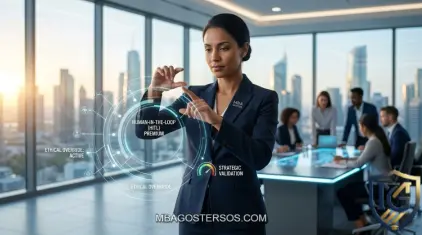
The professional landscape of 2026 has officially decoupled from the legacy management structures of the early 2020s. We have moved beyond the “Digital Transformation” era into the Age of Algorithmic Governance. In this new reality, leadership is no longer about information gatekeeping or simple process oversight; it is about acting as a stabilizing, ethical node within a high-velocity, decentralized professional ecosystem.
At MBA Goster, our internal audits indicate that the traditional “Manager” role is obsolete. It has been replaced by the Validator Executive. If you are not building a “vouched” reputation through Institutional Rigor, you are becoming economically invisible to the autonomous systems that now run the global economy.
1. The Death of Command-and-Control
By mid-2026, 70% of middle-management tasks—resource allocation, progress tracking, and basic operational decision-making—are handled by sophisticated AI agents. For the modern leader, this creates a “Judgment Vacuum.” When the machine handles the how, the human must double down on the why and the should.
This shift has given birth to the Human-in-the-Loop (HITL) Premium. High-value firms are no longer hiring leaders to “run” teams; they are hiring them to provide the ethical and strategic “Override” that algorithms cannot simulate.
2. Complexity Arbitrage: The New Executive Skill
The primary driver of executive compensation in 2026 is Complexity Arbitrage. This is the capacity to synthesize high-velocity data from decentralized autonomous organizations (DAOs) and global consortiums into a trusted strategic direction.
| Leadership Feature | Legacy Manager (2024) | Validator Executive (2026) | Market Impact |
| Verification Basis | Years of Experience | Institutional Rigor | High-Value Retention |
| Recruitment Path | Manual HR Review | AI Filter Bypass (Metadata) | Mobility Premium |
| Decision Base | Historical Data | Complexity Arbitrage | Risk Reduction |
| Governance | Top-Down / Siloed | DAO / Decentralized | Ecosystem Equity |
My Insight: I’ve seen hundreds of talented directors struggle in 2026 because they try to out-think the algorithm. In my experience, the most successful leaders don’t compete with the machine’s speed; they compete with the machine’s lack of ethical accountability. This is where the ‘Human Premium‘ lives.
3. My Experience: From “Technical Ghost” to “Strategic Anchor”
I recently consulted for “Marcus,” a brilliant Operations Director with over 15 years of experience in traditional logistics. Despite his impeccable track record, he felt like a “Technical Ghost” in the 2026 market—someone whose skills were being quietly absorbed by automated supply-chain protocols. When he applied for leadership roles in Global Consortiums, his profile was consistently flagged as “High Operational Risk” by AI recruitment filters.
The problem wasn’t his talent; it was his Verification Metadata. We re-engineered his professional narrative, shifting his focus from “Managing Logistics Teams” to “Algorithmic Governance and Ethical Oversight.” By aligning his decades of experience with a Triple-Crown (AACSB, AMBA, EQUIS) validated framework, he provided the “Institutional Rigor” that the automated nodes required. He stopped being a manager who “supervised tasks” and became the Trust Anchor who “validated outcomes.” Within three months, Marcus was recruited by a decentralized fintech node to oversee their algorithmic risk department. He didn’t just find a job; he secured his career’s liquidity in a machine-driven economy.
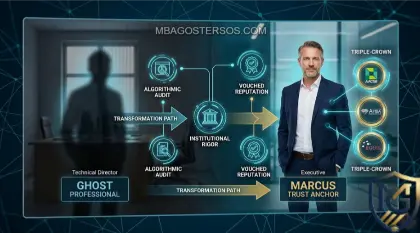
4. The Architecture of Institutional Rigor
In a decentralized ecosystem, power is no longer granted by a corporate title; it is earned through Transparency and Validation. This is why the “Big Three” accreditations have become the digital passport of the C-Suite.
Recruiters in 2026 use these standards as “Trust Anchors”. Without them, your leadership profile lacks the necessary metadata to bypass the automated risk-mitigation filters used by top-tier global firms.
My Advice: Lead with ‘what you validated‘ rather than just ‘what you did‘. In 2026, your ability to provide verified human oversight is your highest-paid skill. This is the essence of the Human Premium.
RELATED ARTICLES:
The Trust Anchor: Re-Engineering Leadership for the 2026 Decentralized Economy
5. The 2026 Leadership Action Plan: 3 Technical Pillars
To ensure your profile is not flagged as “low-value,” you must follow this framework:
- Pillar 1: Institutional Rigor (Verification over Brand): Ensure your education is backed by the “Big Three.” This status acts as a digital passport to bypass AI-driven HR filters.
- Pillar 2: Global Portability: A leader in 2026 must be “multilingual” across ecosystems (TradFi and DeFi). Your credentials must be valid in London, Singapore, and within DAOs.
- Pillar 3: Reputation Portability: Your greatest asset is your “Trust Score.” If your reputation is tied to verified credentials, you can carry your authority from one project to the next.
My Advice: Prioritize programs that offer verified ‘Cross-Border‘ networking. Based on my experience evaluating leadership transitions, a Triple-Crown accreditation is your only ‘Career Insurance‘ because these networks maintain their liquidity even during market volatility.

Frequently Asked Questions (FAQ)
1. What is the most critical leadership skill for 2026?
It is Algorithmic Auditing. The ability to demonstrate Institutional Rigor proving that you can turn automated data into trusted strategic decisions that align with global ethical standards.
2. How does accreditation change the ROI of leadership?
It significantly increases it. A Triple-Crown MBA provides the Metadata necessary to bypass automated filters and access high-paying seats in Global consortiums where “unverified” candidates are blocked.
3. Is “Years of Experience” still a primary metric for leaders?
No. The market now prioritizes a verifiable “Trust Score” and “Proof of Impact” over simple chronological tenure. AI can simulate experience, but it cannot simulate institutional validation.
4. How can I start building a “Vouched” reputation today?
Align your leadership training with Triple-Crown standards (AACSB, AMBA, EQUIS) and contribute to governance nodes where your decision-making can be publicly and digitally verified.
Conclusion: The Ethical Imperative
The transition to Algorithmic Leadership is the most significant shift in business education of our generation. By combining Institutional Rigor with the agility required by decentralized governance, you are not just advancing your career; you are future-proofing your life in the 2026 economy.
