Beyond Networking: Building Trust Ecosystems in the 2026 Decentralized Economy
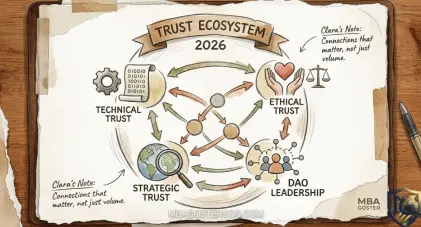
For decades, “networking” was about the quantity of connections the size of your LinkedIn graph or the stack of business cards on your desk. In 2026, that model is dead. In an era where AI agents can simulate professional outreach and automated bots manage “engagement,” a large network is no longer an asset; often, it’s just noise.
The new leadership superpower is the ability to build and navigate Trust Ecosystems.
From Linear Careers to the “Career Web”
In 2026, the traditional corporate ladder has been replaced by the Career Web. Leaders no longer move vertically within a single organization; they move fluidly between fractional roles, DAOs (Decentralized Autonomous Organizations), and cross-industry consortiums.
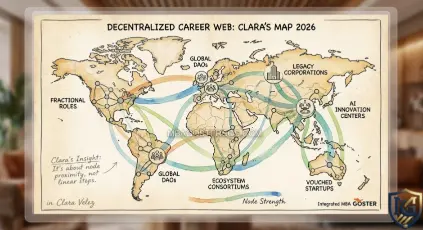
My Insight: “I see many leaders stuck in the 2020 mindset, trying to ‘climb‘ a ladder that no longer exists. Today, your career value is determined by your ‘Node Strength‘ how much trust you’ve cultivated within specific, high-value ecosystems. It’s not about who you know, but who is willing to vouch for your ethical judgment when the data gets messy.”
The ROI of “Proof of Value” (PoV)
In the decentralized economy, credentials are the baseline, but Proof of Value is the currency. Trust Ecosystems rely on verifiable impact. Leaders who thrive in 2026 are those who contribute specialized “micro-value” to ecosystems before asking for a seat at the table.
Networking 2020 vs. Trust Ecosystems 2026
| Feature | Legacy Networking (2020) | Trust Ecosystems (2026) |
| Primary Goal | Information gathering. | Collaborative value creation. |
| Metric of Success | Number of connections. | Depth of “Vouched” authority. |
| Interaction Style | Transactional (Quid pro quo). | Systemic (Contribution first). |
| Primary Tool | LinkedIn / Physical Events. | DAO Governance / Specialized Communities. |
Experience: The “Ghost” Professional
I recently coached “Julian,” a brilliant CFO who had spent 15 years in traditional banking. When he tried to transition into a leadership role within a Green-Tech DAO, he was ignored. On paper, he was overqualified. In reality, he had zero “Proof of Value” in that specific ecosystem.
We shifted his strategy. Instead of “networking,” he began contributing financial auditing models to a decentralized sustainability protocol as a volunteer contributor. Within four months, he was invited to lead their treasury.
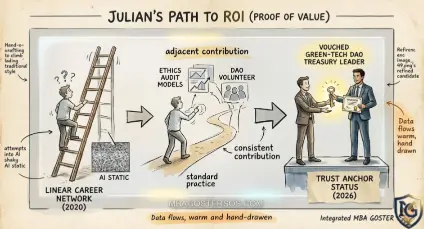
My Insight: “Julian had to learn that in 2026, you don’t ‘apply‘ for a role in a trust ecosystem; you ‘emerge‘ as the logical choice through consistent, high-integrity contribution.”
RELATED ARTICLES:
The 2026 Leadership Blueprint: Why “Holistic Humanism” is the New MBA Superpower
Navigating Career Verticals in 2026
To build your leadership ROI, you must master three distinct types of trust:
- Technical Trust: Can you audit the AI’s output?
- Ethical Trust: Will you prioritize human impact over algorithmic efficiency?
- Strategic Trust: Can you see the “nodes” connecting disparate industries?
2026 Leadership Competency ROI
| Competency Area | Career Catalyst | 2026 Market Value |
| Fractal Leadership | Managing multi-DAO projects. | Maximum (High Differentiator). |
| Algorithmic Auditing | Ensuring AI alignment with ESG. | High (High Utility). |
| Standard Management | Traditional team oversight. | Low (Baseline requirement). |
Frequently Asked Questions (FAQ)
1. Does “Trust Ecosystems” mean I need to be an expert in Blockchain?
No. While many ecosystems in 2026 use blockchain for verification, the “trust” part is human. You need to understand how decentralized governance works, but your value lies in your human judgment, not your ability to code smart contracts.
2. How do I start building a Trust Ecosystem if I’ve only worked in traditional firms?
Start with “Adjacent Contribution.” Identify an ecosystem (a professional group, a DAO, or a research consortium) that interests you and contribute your existing expertise (Finance, Marketing, Strategy) to a public project. Build your PoV (Proof of Value) openly.
3. Is “Networking” still relevant for MBA admissions in 2026?
AdComs now look for “Ecosystem Impact.” They aren’t impressed by a long list of mentors; they want to see where you have been a “Trust Anchor” a person who has facilitated value for others in a community.
Conclusion: The Anchor in the Storm
As the decentralized economy grows more complex, the demand for “Trust Anchors” will only increase. Careers in 2026 are built on the solid ground of integrity and the fluid ability to connect with others across diverse platforms. Stop networking. Start contributing.
