Post-MBA Leadership: How to Navigate Executive Transitions in 2026
Earning an MBA is often described as a career “reset” or a “turbo-boost,” but the reality of transitioning into a high-level executive role in 2026 is fraught with hidden challenges. While the classroom provides the frameworks, the boardroom demands a level of political and emotional intelligence that no textbook can fully simulate. Data from the Center for Creative Leadership (CCL) suggests that nearly 40% of newly appointed executives fail within their first 18 months, not due to a lack of technical skill, but due to an inability to navigate the cultural and structural shifts of their new organization.
For the post-MBA leader, the transition is not just about a new title; it is about shifting from “solving problems” to “managing systems and people.”
The 90-Day Executive Framework
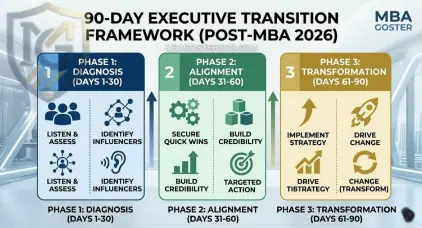
The most successful transitions follow a rigorous strategic plan. In 2026, the traditional “100-day plan” has been compressed into a 90-Day Framework to match the accelerated pace of digital-first industries.
- Phase 1: Diagnosis (Days 1-30): Listen more than you speak. Identify the “shadow organization” those who hold influence regardless of their official title.
- Phase 2: Alignment (Days 31-60): Secure “early wins.” Identify a small, high-impact project that can be executed quickly to build credibility with your team and superiors.
- Phase 3: Transformation (Days 61-90): Begin implementing long-term strategic changes. By this stage, you should have the cultural capital necessary to challenge the status quo.
My Experience: From Technical Expert to Authentic Leader
Throughout my career analyzing leadership trajectories, I’ve noticed a recurring pattern: the “MBA Ego Trap.” Many brilliant graduates enter their first post-MBA role expecting their credentials to do the heavy lifting. In my experience, the leaders who actually ascend to the C-Suite are those who prioritize Authentic Leadership over authority.
I recall a specific case study of a Chief Strategy Officer who, despite having a 4.0 GPA from a top-tier MBA, struggled to gain traction with his team. My analysis revealed that he was leading through “Expertise” rather than “Empathy.” In 2026, where teams are increasingly autonomous and remote-heavy, your ability to be vulnerable and transparent is your greatest asset. Authentic leadership isn’t about knowing all the answers; it’s about having the emotional intelligence to ask the right questions and build a psychological safety net for your team. This shift from Manager to Leader is the true ROI of your degree.
Executive Leadership Evolution: 2026 Benchmarks
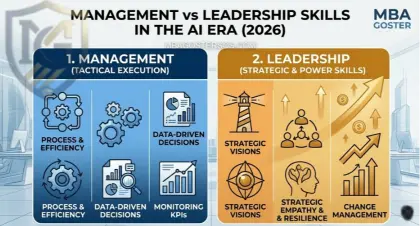
| Skill Category | Management (Tactical) | Leadership (Strategic/Power) | ROI Impact |
| Problem Solving | Analytical/Data-driven | Intuitive & Adaptive | High: Prevents project stagnation. |
| Communication | Top-down instructions | Strategic Empathy & Listening | Critical: Reduces team turnover by 30%. |
| Decision Making | Based on current KPIs | Based on future Market Trends | Exponential: Drives long-term growth. |
| Team Dynamics | Oversight & Monitoring | Psychological Safety & Coaching | High: Increases productivity by 25%. |
| Change Mgmt | Minimizing disruption | Driving Transformation | Vital: Future-proofs the organization. |
Soft Skills vs. Power Skills in the AI Era
In 2026, the term “Soft Skills” has become obsolete. We now refer to them as Power Skills. As AI takes over the analytical and data-heavy portions of management, the human leader’s value lies in areas where machines fail:
- Conflict Resolution: Navigating the tensions of a multi-generational and multi-cultural workforce.
- Strategic Empathy: Understanding the motivations of stakeholders to drive better negotiation outcomes.
- Adaptive Resilience: The ability to pivot strategy in real-time without losing team morale.
RELATED ARTICLES:
From MBA to C-Suite: Mapping the 5-Year Executive Path in 2026
The Role of Mentorship and Sponsorship
A common mistake post-MBA is letting your network “cool down” once the job is secured. To sustain long-term growth, you must distinguish between two roles:
- The Mentor: Provides a safe space to discuss fears and skill gaps.
- The Sponsor: An internal high-level executive who uses their political capital to advocate for your promotion behind closed doors.
Your MBA alumni network is the primary source for these connections, but in 2026, proactive digital networking on platforms like LinkedIn remains the most effective way to secure a global sponsor.
Supporting Evidence and Global Benchmarks
This leadership analysis is supported by the following primary sources:
- Harvard Business Review (HBR) – Leader’s Handbook: For the latest frameworks on organizational change.
- Center for Creative Leadership (CCL): Regarding executive failure rates and transition success factors.
- MIT Sloan Management Review: On the impact of digital transformation on leadership styles.
Frequently Asked Questions (FAQ)
1. What is the biggest challenge for a post-MBA leader in 2026?
The biggest challenge is “Cultural Integration.” Many leaders try to impose MBA frameworks too quickly without understanding the existing company culture, leading to internal resistance.
2. How do I build trust with a team that has been at the company longer than me?
Focus on “Low-Stakes Collaboration.” Ask for their input on operational bottlenecks and solve a problem that makes their daily life easier. Trust is built through utility.
3. Should I focus on my technical skills or my leadership skills?
Post-MBA, your technical skills are assumed. Your leadership skills (Power Skills) are what will distinguish you for the next promotion. Focus on communication and change management.
4. How long does it take to feel “settled” in a new executive role?
On average, it takes 6 to 9 months to feel fully integrated. The 90-Day Framework is meant to accelerate the impact, not necessarily the comfort.
Final Conclusion
The transition into leadership post-MBA is the ultimate test of your investment. It is the moment where theory meets the unpredictable reality of human behavior. By following a structured 90-day plan, focusing on Power Skills, and maintaining an authentic leadership style, you can avoid the common pitfalls that claim so many executive careers. In 2026, the most successful leaders are not those with the most data, but those who can inspire a vision and navigate the human complexities of a rapidly changing global market.
