MBA Accreditations & Admissions 2026: The Ultimate Guide to the “Triple Crown”

In the rapidly evolving business landscape of 2026, a Master of Business Administration (MBA) is more than just a degree it is a significant financial and professional pivot. However, as online programs and “fast-track” certifications proliferate, the value of your investment hinges on one critical factor: Accreditation.
Choosing a school without the proper credentials isn’t just a risk; in the age of AI-driven recruitment, it can be a career-ending mistake. This guide breaks down the rigorous world of global accreditations and the new holistic standards of 2026 admissions.
The “Triple Crown”: Why It Matters in 2026
The “Triple Crown” refers to schools accredited by the three most influential organizations: AACSB (United States), EQUIS (Europe), and AMBA (Global). In 2026, holding a degree from a Triple Crown school is the only way to ensure your profile passes the automated filters of top-tier global consultancies and tech giants.
Global Accreditation Comparison (2026 Standards)
| Accreditation | Focus Area | Global Recognition | Best For… |
| AACSB | Academic Excellence & Research | 100% (Gold Standard) | US-based & Global Corporate Roles |
| EQUIS | Internationalization & Diversity | High (Global) | Careers in Europe & Multinationals |
| AMBA | Program-Specific Quality | High (Portfolio) | Experienced Professionals & MBAs |
| ACBSP | Teaching Excellence | Moderate | Small to Mid-sized Regional Firms |
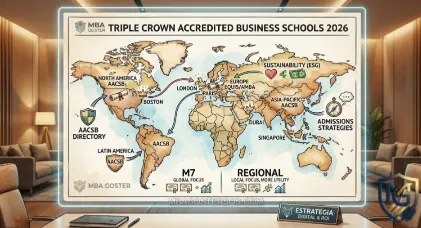
My advice is: “Don’t just look for a logo on a website. Go to the official AACSB Directory and verify it yourself. I’ve seen brilliant candidates lose job offers at the final stage because their ‘prestigious‘ school turned out to be nationally accredited but globally unrecognized.”
The 2026 Admission Landscape: Beyond the GMAT
While test scores remain a benchmark, 2026 has ushered in the era of “Holistic Humanism.” Admissions committees (AdComs) are no longer just looking for “smart” people; they are looking for leaders who can navigate the ethical complexities of Artificial Intelligence and decentralized workforces.
Weight of Admission Components in 2026
| Component | Weight (%) | Strategic Focus for 2026 |
| GMAT Focus Edition / GRE | 30% | Quantitative reasoning is prioritized over memorization. |
| Essays & Personal Branding | 25% | Must demonstrate “AI-Resilience” and ethical leadership. |
| Professional Experience | 20% | Quality of impact beats years of tenure. |
| Interview Performance | 15% | High emotional intelligence (EQ) is the main filter. |
| Letters of Recommendation | 10% | Evidence of soft skills in a digital environment. |

My Experience: The “Perfect” Candidate vs. The “Real” Leader
Last admissions cycle, I worked with “Sofia,” a software engineer with a 760 GMAT score. On paper, she was perfect. However, her essays were cold, robotic, and lacked a “human” narrative. She was rejected from three Top-10 schools.
Contrast this with “David,” who had a modest 680 GMAT but had spent three years managing a remote team of developers across four time zones. In his essays, David didn’t just talk about his technical wins; he talked about how he managed the mental health of his team during a pivot.
My Personal Reflection: “AdComs are terrified of admitting ‘AI-generated’ personalities. In 2026, your greatest asset is your vulnerability. Talk about a time you failed or a moment you felt overwhelmed. That’s what makes you a leader, not your perfect spreadsheet.”
RELATED ARTICLES:
Beyond the GMAT: Decoding the 2026 MBA Accreditation Standards
Understanding Accreditations: A Deep Dive
AACSB: The Research Powerhouse
The AACSB remains the most difficult accreditation to achieve. It requires a school to prove that its faculty is not just teaching, but actively contributing to the global body of business knowledge. In 2026, this includes research on Sustainable Finance and AI Governance.
EQUIS: The Global Connector
If your goal is to work in London, Singapore, or Dubai, EQUIS is vital. This accreditation focuses on how well the school integrates with the corporate world. Schools like INSEAD and LBS excel here because of their deep ties to global industry hubs.
Regional Accreditation Power Rankings 2026
| Region | Primary Authority | Secondary Value |
| North America | AACSB | Regional (SACS/HLC) |
| Europe | EQUIS / AMBA | AACSB (for prestige) |
| Asia-Pacific | AACSB | EQUIS |
| Latin America | AACSB | AMBA |
Frequently Asked Questions (FAQ)
1. Is an unaccredited MBA worth it for a lower price?
In short: No. In 2026, many recruitment AI bots are programmed to skip resumes from schools that do not appear in the EMBAC or AACSB databases. You might save money now, but you will lose ROI in the long run.
2. Does the “GMAT Focus Edition” replace the old GMAT?
Yes, as of 2026, the Focus Edition is the global standard. It is shorter and more analytical. Schools are placing more weight on the “Data Insights” section, reflecting the modern need for data-literate managers.
3. How do I know if a school is “Green-Washing” its accreditation?
Check if they mention Sustainability (ESG) only in their marketing or if it’s embedded in their core curriculum. Real accredited schools have measurable impact reports.
My opinion is: “When you interview, ask the school: ‘How did your curriculum change in the last 12 months due to AI?’ If they don’t have a specific answer, their accreditation might be a legacy title rather than a current standard of excellence.”
Conclusion: Don’t Settle for Less
Your MBA is likely the most expensive asset you will ever purchase. In 2026, the difference between a high-growth career and a stagnant one often comes down to the quality of the institution behind your name. By prioritizing schools with the AACSB and Triple Crown status, you are not just buying a degree; you are buying a lifetime of global mobility and financial security.
Remember: Prestige opens the door, but Accreditation keeps it open.
