The 2026 MBA Payback Manifesto: Decoding the Death of the “Prestige Premium”
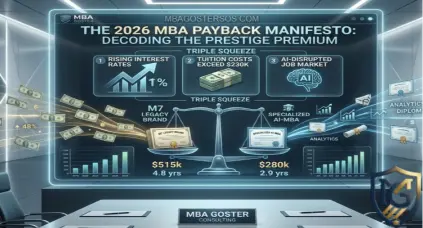
For decades, the path to corporate glory was paved with a single, undisputed truth: get into an M7 school, take on the six-figure debt, and the ROI will take care of itself. But as we navigate the economic landscape of 2026, that “truth” has become a dangerous myth. Today’s candidates are facing a “Triple Squeeze“: rising interest rates, tuition costs exceeding $230,000, and an AI-disrupted job market that values demonstrable skills over legacy pedigrees. MBA
If you are evaluating an MBA solely on a 2020 ranking, you aren’t just making a career mistake you are making a catastrophic financial one. This is the era of the Utility MBA.
The Financial Reality: Why the “Payback Period” is the Only Metric That Matters
In 2026, we no longer talk about “starting salaries” in isolation. We talk about the Net Present Value (NPV) of the degree. The traditional calculation comparing your pre-MBA salary to your post-MBA salary is fundamentally flawed because it ignores the Opportunity Cost.
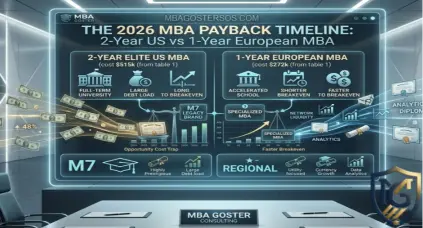
The “True Cost” of Attendance (2026 Projections)
| Expense Category | 2-Year Elite US MBA | 1-Year European MBA | 2-Year Regional Tech-MBA |
| Direct Tuition & Fees | $165,000 | $105,000 | $95,000 |
| Living Expenses (HCOL) | $65,000 | $35,000 | $45,000 |
| Foregone Salary (2 yrs) | $240,000 | $120,000 | $200,000 |
| Loan Interest (7.5% avg) | $45,000 | $12,000 | $18,000 |
| TOTAL INVESTMENT | $515,000 | $272,000 | $358,000 |
Sector Divergence: Where the Real ROI Lives in 2026
The market has bifurcated. While traditional Investment Banking and Strategy Consulting still offer high bases, they no longer offer the highest relative growth.
2026 Post-MBA Compensation by Emerging Sector
| Industry Sector | Median Base Salary | Signing Bonus | 5-Year Equity Potential |
| Generative AI Strategy | $198,000 | $45,000 | High (Stock Options) |
| Fintech Ops (Digital Assets) | $175,000 | $30,000 | Moderate / High |
| ESG & Green Finance | $168,000 | $25,000 | Stable Growth |
| Traditional Consulting | $185,000 | $35,000 | Linear / Bonus-heavy |
My Experience: The “Logo” vs. The “Leap”
Last year, I sat across from a brilliant candidate, “Mark,” who had a full-tuition scholarship to a respected regional school in Austin (ranked around #35) and an unfunded offer from a Top-3 “Legacy” school in the Northeast. Mark was obsessed with the “Logo.” He felt that without the Ivy League brand, his career would hit a ceiling.
We did a deep-dive audit into his goals: he wanted to lead product at a Series C tech startup. We looked at the alumni data. The regional school had a 65% higher “Response Rate” from Austin-based tech founders than the elite school. Why? Because the regional school’s curriculum was built around the local tech ecosystem.
Mark chose the regional school. Two years later, he graduated debt-free. His starting salary was $165,000. His peers from the Top-3 school started at $185,000 but were carrying $250,000 in debt at high interest. Mark’s net worth in 2026 is already $180k higher than his “Elite” counterparts. The lesson? In 2026, Network Liquidity (how fast your network converts into a job) beats Network Size every time.
RELATED ARTICLES:
The 2026 MBA Payback Equation: Calculating Real-World ROI
The 2026 ROI Formula: A Step-by-Step Audit
Before you sign that loan agreement, run this audit:
- The 25% Liquidity Test: Your total student debt should not exceed 1.25x your expected first-year post-MBA salary.
- The Industry Alignment Check: Does the school’s career center have dedicated recruiters for the sectors listed in the PwC Fintech Hub reports?
- The VHCOL Adjustment: If the school is in a VHCOL area, add a 15% “tax” to your ROI calculation.

Network Liquidity vs. School Ranking
| School Tier | Alumni Response Rate | Placement in Top 10 Hubs | Avg. Time to Offer |
| M7 (Global Elite) | 78% | 92% | 3.2 Months |
| Top 20 (Regional Hub) | 85% (Local) | 65% (National) | 2.8 Months |
| Online / Hybrid | 42% | 45% | 5.5 Months |
Frequently Asked Questions (FAQ)
Is a 1-year MBA always better for ROI?
From a purely mathematical standpoint, yes. Schools like INSEAD or IMD reduce the opportunity cost by 50%. However, if you are a “career switcher,” you need the 2-year format’s summer internship to prove your value to recruiters.
How does the “Alumni Engagement Rate” impact my salary?
A school might have 100,000 alumni, but if their response rate is low, the ROI is zero. According to EMBAC research, Executive MBA networks often have higher “active liquidity.”
Can I negotiate my financial aid package in 2026?
Absolutely. Schools are competing for “Diverse Skillsets” (AI experts, engineers). If you have an offer from a peer school, use it as leverage.
Conclusion: Investing in Your 2030 Self
The MBA is no longer a rite of passage; it is a high-stakes capital allocation. In 2026, the winners are those who look past the glossy brochures and the 1990s-era prestige. They are the candidates who calculate their NPV, prioritize Skill-to-Market Alignment, and understand that a debt-free degree from a “Tier 2” school often yields a more powerful life than a “Tier 1” degree that feels like a mortgage.
Your goal isn’t to have the best resume in the room; it’s to have the most profitable career in the market. Choose your school based on where the world is going in 2030, not where it was in 2020.
